
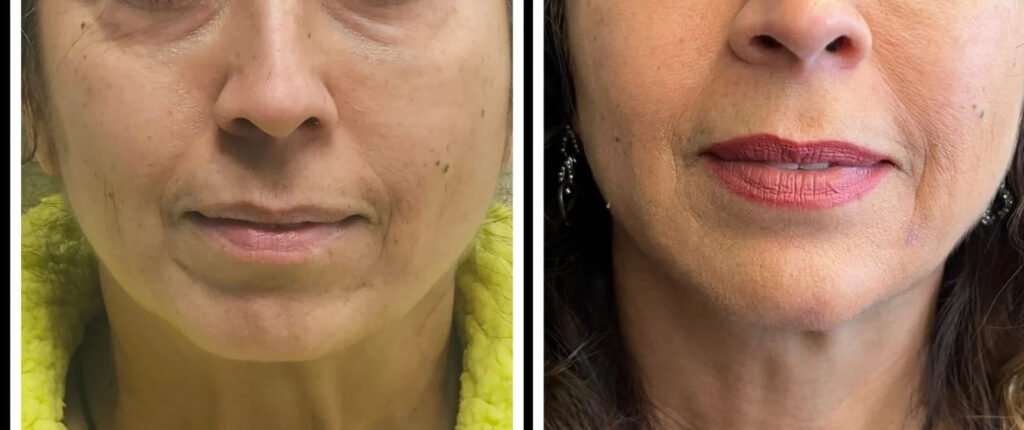
Radiesse is one of the longer-lasting options in the injectable world, and it’s worth understanding why before deciding whether it’s the right fit for you. The short answer: most patients see results for 12 to 18 months, noticeably longer than typical hyaluronic acid filler, which averages 6 to 12 months. The longer answer depends quite a bit on where it’s placed.
Why Radiesse lasts longer than regular filler in the first place
Radiesse is made from calcium hydroxylapatite (CaHA) microspheres suspended in a gel carrier — a genuinely different mechanism from hyaluronic acid fillers like the kind used in lip or under-eye treatments. This is exactly why it’s classified as a biostimulator rather than a standard filler, which we covered in more depth in our earlier post, Radiesse & Sculptra Explained.
The gel provides immediate volume the moment it’s injected. Over the following weeks and months, the CaHA microspheres stimulate your own fibroblasts to produce new collagen — meaning the treated area doesn’t just hold its shape from the filler itself, it gradually gains genuine structural support from collagen your body builds in response. That’s the part that gives Radiesse its longer lifespan compared to hyaluronic acid fillers, which simply sit in place until your body metabolizes them.
Timeline by area — because it genuinely isn’t one number
- Jawline: Typically 12 to 15 months. The jawline moves constantly through speech and expression, which causes the product to break down a bit faster than in less mobile areas.
- Cheeks: Often up to 18 months, sometimes longer. Cheeks move far less than the lower face, so filler placed here tends to hold its shape the longest.
- Nasolabial folds / smile lines: Around 12 months on average, though this varies with skin type and age.
- Hands: Commonly used for volume restoration here too, with a similar 12–18 month range.
What the timeline actually looks like week by week
Right after treatment, you’ll see immediate volume — that’s the gel doing its job. Over the next 24 to 48 hours, some swelling is normal and typically settles quickly. It takes roughly 10 to 14 days for your skin to start visibly benefiting from the collagen your body begins producing in response, and results generally continue to subtly improve over the following months as that collagen builds. This gradual improvement is part of why Radiesse tends to look more “you, but better rested” rather than obviously done — the change happens slowly enough that it reads as natural.
Can Radiesse be dissolved if you don’t like it?
No — and this is an important difference from hyaluronic acid filler. Because Radiesse isn’t hyaluronic-acid based, it can’t be reversed with the hyaluronidase enzyme used for HA fillers. This is exactly why an honest consultation and a conservative starting approach matter more with Radiesse than with reversible fillers — it’s not a treatment to go into casually or over-correct on a first visit.
What actually affects how long yours will last
- Metabolism — a faster metabolic rate tends to break the product down somewhat quicker
- Treatment area — as covered above, movement matters
- Skin condition — healthier, better-hydrated skin tends to hold results longer
- Amount used and technique — precise placement by an experienced injector makes a real difference in both how natural it looks and how evenly it wears over time
Is Radiesse worth choosing over a hyaluronic acid filler?
It depends what you’re solving for. If you want structural, longer-lasting support in the cheeks or jawline and you’re comfortable with a filler that can’t be dissolved, Radiesse’s extended timeline makes it genuinely cost-effective over time compared to touching up HA filler every 6–12 months. If you’re newer to injectables and want the reversibility option as a safety net, starting with hyaluronic acid filler first — covered in our dermal fillers guide — may be the more comfortable starting point before considering Radiesse later.
Quick answers
Does Radiesse hurt more than regular filler? Discomfort level is similar to standard filler injections; most patients tolerate it well, sometimes with topical numbing beforehand.
Can Radiesse be used anywhere on the face? It’s typically used for structural areas like cheeks, jawline, chin, and hands — it’s not generally used in the lips or under-eyes, where hyaluronic acid filler is the more appropriate choice.
How soon can I get a touch-up? Most patients wait until closer to the 12-month mark, once they start noticing volume settling, rather than touching up on a fixed schedule.
Getting a timeline specific to your face
The ranges above are averages, not guarantees — your actual timeline depends on your skin, your metabolism, and exactly where treatment is placed. At MJ Aesthetics in North York, Radiesse and Sculptra pricing is based on consultation and in-person assessment, precisely because the right amount and placement genuinely varies person to person.
Radiesse is often compared with Sculptra. If you would like to read about the other option, see our Sculptra page, which covers how it works and what to expect.
Book a free consultation with Mehran Javidan, IMG, to find out what a realistic timeline looks like for you.