
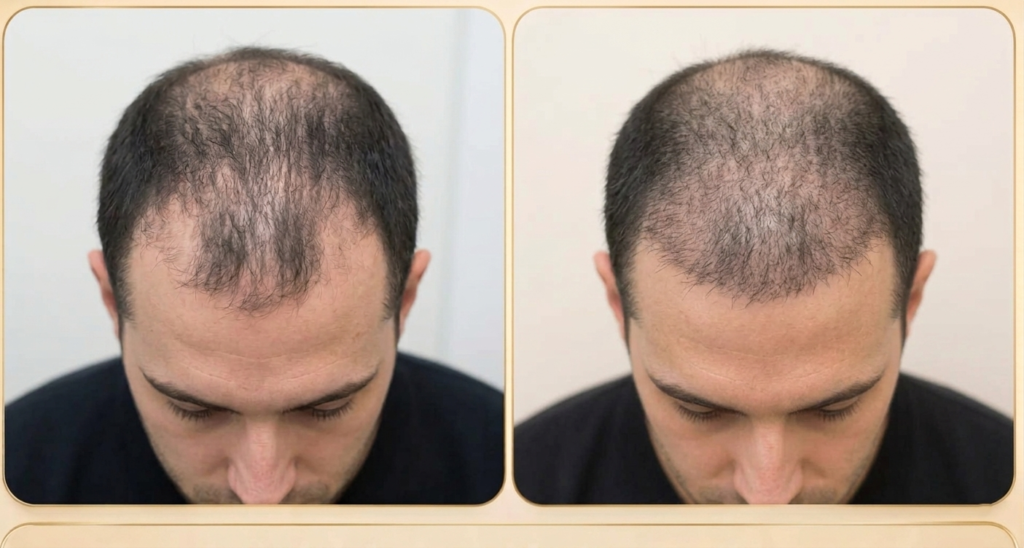
If you’ve started noticing more hair in the shower drain than you used to, you’ve probably already come across PRP as an option. It’s one of the most requested treatments at MJ Aesthetics, and for good reason — but it’s also one of the most misunderstood, mostly because “does it actually work” doesn’t have a one-line answer.
Here’s what PRP hair restoration actually is, what a realistic timeline looks like, and how to know if it’s worth considering for you.
What PRP Hair Restoration Actually Does
PRP (platelet-rich plasma) uses a concentrated portion of your own blood to support the natural hair-growth environment. A small blood sample is drawn, processed to concentrate the platelets, and injected into the scalp. Those platelets release growth factors that support the local scalp environment around hair follicles — the goal is to work with follicles that are still active but weakened, not to create new ones from nothing.
That distinction matters. PRP is generally considered appropriate for individuals experiencing hair thinning, reduced density, or early-to-moderate non-scarring hair loss — not for someone who’s already lost hair follicles entirely in a given area. If you’re at that stage, PRP may still play a role, but usually alongside a hair transplant rather than instead of one (more on that below).
How Many Sessions Does It Actually Take?
This is the question almost everyone asks, and the honest answer is: it depends on your starting point, but most people begin with a series of three sessions spaced four to six weeks apart. That’s the structure behind our own PRP Hair Regrowth Therapy package. More advanced thinning sometimes calls for a slightly longer initial series, and results are typically maintained afterward with periodic follow-up sessions every several months — not a one-and-done treatment, but not an endless commitment either.
When Do You Actually See Results?
This is where a lot of people get frustrated if nobody sets expectations up front: PRP is not fast. Most people don’t see dramatic change after the first session — that’s normal, not a sign it isn’t working. Reduced shedding is often the first thing people notice, followed by visible thickening over the following months as the growth cycle responds. Meaningful results typically take three to six months to become apparent, and that timeline is part of why a personalized assessment matters so much before starting — it’s a commitment, and it should be based on a real read of your specific pattern of loss, not a guess.
PRP After a Hair Transplant
PRP isn’t only a standalone treatment. It’s also commonly used as a complementary treatment following hair transplantation, supporting the scalp during the healing and recovery phase and helping create a favorable environment for transplanted follicles. This is exactly what our PRP Exomeso Protocol is built around — a 4-session package designed to support and maximize hair transplant results. If you’ve had a transplant elsewhere, this is worth discussing directly with your transplant physician alongside your PRP provider, since timing and session count should be individualized to your specific procedure and recovery.
Is It Worth It?
That depends entirely on what you’re comparing it to. PRP won’t produce the kind of dense, dramatic regrowth a surgical transplant can in advanced baldness — nothing non-surgical does. What it can offer is a non-surgical, minimally invasive option using your own biology, well suited to earlier-stage thinning, or as genuine support alongside a transplant rather than a replacement for one. The honest starting point isn’t “should I get PRP” — it’s a scalp assessment that tells you whether PRP alone fits your pattern of loss, or whether it makes more sense as part of a broader plan.
We’ve got a full breakdown of PRP hair packages, pricing, and more detailed FAQs — including the post-transplant protocol — on our PRP Treatments page.
Related reading: mesotherapy is sometimes used alongside PRP for hair support too — see our Mesotherapy page.
To find out whether PRP fits your specific pattern of thinning, book a consultation or call 437-556-1119.
Mehran Javidan is an International Medical Graduate (IMG) who is not currently registered as a physician with the College of Physicians and Surgeons of Ontario. He provides aesthetic treatments at MJ Aesthetics under physician delegation, in accordance with Ontario’s Regulated Health Professions Act.