
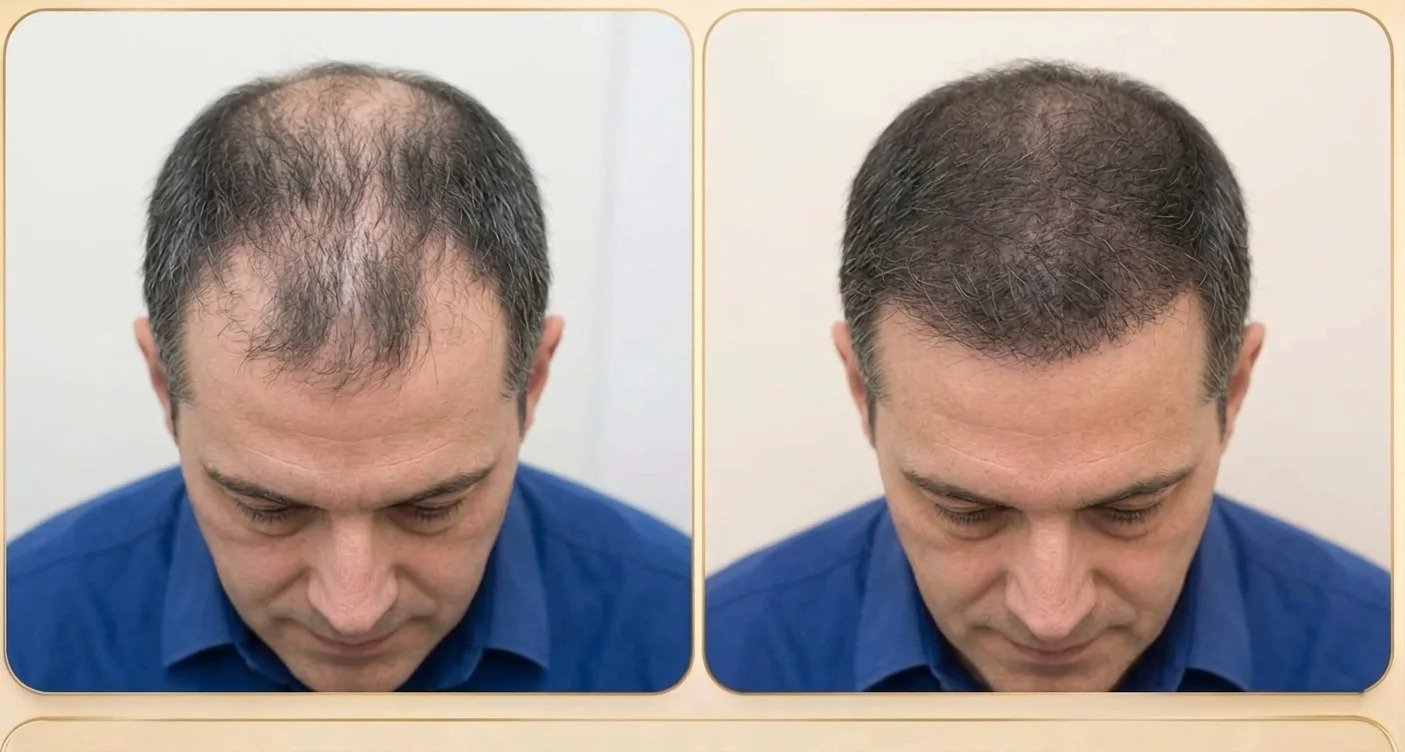
One of the most common questions from patients considering PRP for hair loss is how many treatments it actually takes. The honest answer is that it depends on the individual — but there are clear patterns in how PRP protocols are structured and why multiple sessions are necessary.
Why PRP Requires Multiple Sessions
Platelet-rich plasma (PRP) works by delivering concentrated growth factors directly to the scalp. These growth factors stimulate follicles that are in a weakened or dormant state, encouraging them to return to an active growth phase (anagen). This is a biological process — it doesn’t happen overnight, and a single session rarely delivers enough stimulus to produce meaningful, lasting results.
The follicle response to PRP is cumulative. Each session builds on the one before it. Most clinical protocols are designed around an initial loading phase followed by a maintenance phase, because the biology of hair cycling — which moves through growth, transition, and resting phases over months — requires sustained stimulus to shift the balance toward growth.
Typical PRP Hair Restoration Protocol
While protocols vary between practitioners and are adjusted based on individual response, a common approach is:
- Initial phase: 3 sessions spaced 4–6 weeks apart
- Assessment: Hair density, shedding, and scalp condition evaluated at 3–6 months after completing the initial phase
- Maintenance: 1–2 sessions per year to sustain results
Some patients with more advanced hair loss or slower initial response may require a fourth session in the loading phase. Some with early-stage, responsive hair loss see meaningful change after 3 sessions and maintain well with annual treatments.
What Affects How Many Sessions You’ll Need
Stage of hair loss
PRP is most effective for hair follicles that are still present but miniaturized or dormant — it cannot restore hair from follicles that are entirely gone. Patients in earlier stages of androgenetic alopecia (male or female pattern hair loss) typically see better outcomes and may need fewer sessions than those with more advanced loss.
Cause of hair loss
PRP has the most evidence for androgenetic alopecia. Its role in other conditions — alopecia areata, telogen effluvium, traction alopecia — is less established, and the protocol may differ. The underlying cause needs to be identified before treatment planning.
PRP preparation quality
Not all PRP is the same. The concentration of platelets and growth factors varies depending on the centrifuge system and preparation protocol used. Higher-quality preparation systems generally produce more consistent results.
Individual biology
Some people respond faster and more visibly than others. Factors like age, overall health, scalp condition, and how recently hair loss began all influence response rate. There is no way to predict your exact result in advance — outcome assessment after the initial series is how response is measured.
When to Expect Results
PRP results do not appear immediately. Most patients notice reduced shedding within 4–8 weeks of the first session. Visible improvement in density and hair thickness typically becomes apparent 3–6 months after completing the initial series. In some cases, full assessment isn’t meaningful until 6–9 months after the first treatment.
Before-and-after photographs taken under consistent lighting and magnification are the most reliable way to assess change — subjective impression alone is not sufficient.
Who Is a Good Candidate for PRP Hair Restoration?
Good candidates generally include:
- Adults experiencing early-to-moderate androgenetic alopecia
- Patients with diffuse thinning rather than complete bald patches
- People who want a non-surgical option before considering hair transplant
- Those who want to maintain results after a hair transplant procedure
PRP is generally not recommended for patients with certain blood disorders, active scalp infections, or those taking blood thinners. A thorough medical history review is part of the consultation at MJ Aesthetics.
PRP at MJ Aesthetics North York
At MJ Aesthetics in North York, PRP hair restoration begins with an assessment of your hair loss pattern, history, and goals. Mehran Javidan, IMG, designs a treatment plan based on individual factors — not a one-size-fits-all protocol. All procedures are performed under appropriate physician delegation in accordance with Ontario’s Regulated Health Professions Act.
Related reading: PRP Therapy: Hair, Face, or Both — What Does It Actually Treat?
If you’re ready to find out whether PRP is appropriate for your hair loss, book a consultation at MJ Aesthetics North York.
Frequently Asked Questions
Is one PRP session enough for hair loss?
A single session is unlikely to produce meaningful or lasting results. Clinical protocols consistently recommend an initial series of 3 or more sessions to create the cumulative stimulus required to shift the hair cycle.
How long do PRP hair results last?
Results are not permanent — PRP slows or reverses hair thinning rather than stopping the underlying cause. Most patients require maintenance sessions once or twice yearly to sustain improvement.
Does PRP hurt?
The scalp injections cause brief discomfort. Topical anaesthetic is applied beforehand, and some providers use a local block. Most patients tolerate the procedure well. The scalp may feel tender for a day or two after treatment.