
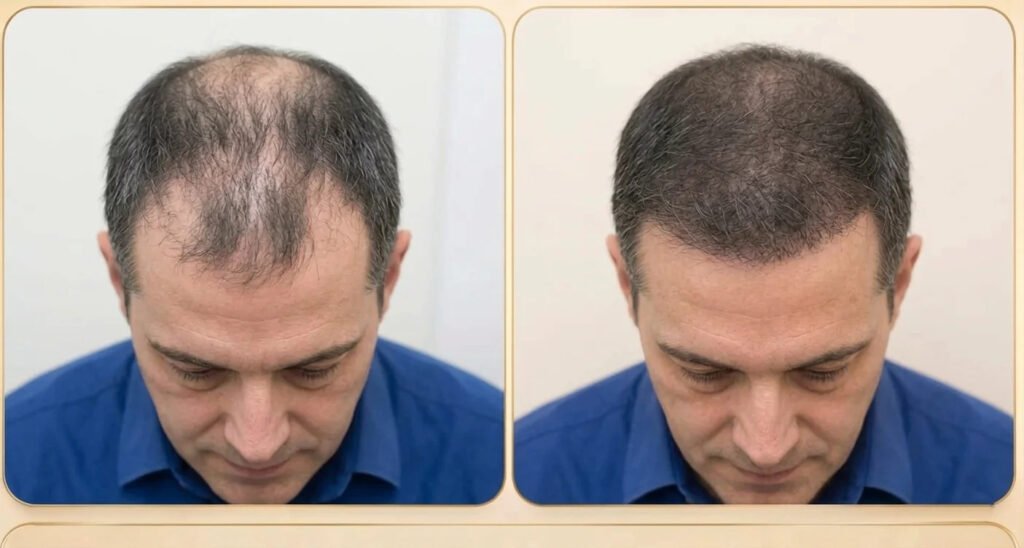
PRP therapy gets mentioned in two completely different contexts — hair restoration and facial rejuvenation — which leaves a lot of people wondering if it’s really the same treatment doing two jobs, or two different things sharing a name. It’s genuinely the same underlying process, platelet-rich plasma drawn from your own blood, but what it’s asked to do (and how it’s delivered) changes quite a bit depending on where it’s used.
The one idea behind both
PRP is created by drawing a small blood sample and spinning it in a centrifuge to concentrate the platelets — which carry growth factors your body naturally uses for tissue repair. That concentrated plasma is then injected back into the treatment area, whether that’s the scalp or the face, where it supports the body’s own healing and regeneration process. Because it’s your own blood, the risk of allergic reaction is minimal, which is part of why it’s become a popular option for people wary of synthetic injectables.
PRP for hair — what it actually does
For thinning hair or early hair loss, PRP is injected into the scalp to wake up existing hair follicles, support a healthier scalp environment, and encourage stronger, thicker regrowth over time. It’s not a treatment for complete baldness or fully dormant follicles — it works best on hair that’s thinning but still active, which is why an honest assessment of your hair loss pattern matters before starting.
At MJ Aesthetics, standard PRP for hair starts at $250 for a single session, with a 3-session regrowth package available as a promotional package at $550 — since hair restoration, more than most treatments, depends on a course of sessions rather than a single visit to see real change. We’ve written a full breakdown of what to expect in our earlier post, PRP Hair Restoration: What to Expect, Does It Work, and Is It Worth It.
PRP for face — what it actually does
For the face, PRP is used to support overall skin quality, tone, and texture, and it’s also commonly used specifically under the eyes, where the skin is thin and delicate and often shows the earliest signs of fatigue and volume loss. Rather than adding volume the way filler does, facial PRP works more gradually, supporting the skin’s own collagen production and overall radiance.
Pricing depends on the area: under-eyes start at $250 for a single session ($600 for three), full face starts at $300 ($700 for three), and combined face-and-neck starts at $450 ($1,100 for three) — reflecting the larger treatment area and time involved.
So — hair, face, or both?
This genuinely comes down to what you’re trying to address, not which is “better.” If thinning hair is your concern, facial PRP won’t touch that. If skin quality and under-eye tiredness is the concern, PRP for hair isn’t relevant. Some patients do both, on separate treatment schedules, simply because they have both concerns — but there’s no combined discount logic here, since they’re really two separate treatment plans that happen to share the same underlying technology.
How is PRP different from mesotherapy, if both are about skin quality?
This is a fair question, and one we’ve answered in detail here: PRP Facial vs. Mesotherapy. In short, PRP uses your own blood’s growth factors for a more regenerative approach, while mesotherapy delivers an external blend of vitamins and hydrating ingredients. Both can be part of the same overall skin plan, at different points.
Quick answers
How many PRP sessions do I actually need? For hair, a 3-session course is the typical starting recommendation, since follicle response builds gradually. For face, a single session can offer a refresh, but a 3-session course tends to produce more noticeable, longer-lasting improvement.
Is PRP painful? Most patients describe it as mild discomfort, similar to any series of small injections — the scalp and under-eye area can feel more sensitive than other areas.
How soon will I see results? PRP results build gradually over several weeks as the growth factors do their work — this isn’t a same-day, visible-in-the-mirror treatment the way filler is.
Finding out which is right for you
Whether PRP makes sense for your hair, your skin, or both really depends on an honest look at what’s actually happening — hair loss pattern, skin concerns, and your overall goals. At MJ Aesthetics in North York, Mehran Javidan, IMG, assesses candidacy for each area individually rather than treating PRP as a one-size-fits-all add-on.
Book a free consultation to talk through whether PRP for hair, face, or both fits what you’re looking for.