
If you’ve been researching regenerative aesthetics lately, you’ve probably come across the word “exosomes.” They’re suddenly everywhere — in skin treatments, hair treatments, post-procedure protocols — and the way they’re discussed online can make them sound like a miracle ingredient that does everything from reversing aging to regrowing hair.
The reality is more interesting than that, and also more nuanced. Exosome-based treatments are an emerging area of regenerative aesthetics, and understanding what they actually are, what they’re being studied for, and what they aren’t can help you have a much more useful conversation before deciding whether they’re appropriate for you.
What Are Exosomes, Exactly?
Exosomes are tiny extracellular vesicles released by cells. Think of them as microscopic carriers involved in cell-to-cell communication — they can carry proteins, lipids, and other signaling molecules that influence how neighboring cells behave.
That’s the basic science behind the interest in exosome-based treatments: researchers are studying whether these signaling properties can be used to support tissue repair, skin quality, and other regenerative processes.
But there’s an important distinction between research interest and proven clinical outcomes. Exosome science is developing quickly, but not every claim you see in aesthetic marketing has the same level of evidence behind it.
That’s why we describe exosome-based treatment at MJ Aesthetics as an emerging, evolving area of regenerative aesthetics, rather than presenting it as a guaranteed solution for a particular concern.
Why Are Exosomes Used in Aesthetics?
The interest in exosomes comes largely from their potential role in cell signaling and tissue regeneration.
In aesthetic medicine, they’re being explored for applications involving skin quality, rejuvenation, healing support, and hair and scalp treatments. The idea isn’t that exosomes simply “fill” a wrinkle or physically add volume. Instead, they’re being studied for their potential to influence the biological environment around treated tissues.
That’s fundamentally different from what Botox or dermal fillers do.
Botox targets muscle activity associated with dynamic wrinkles. Dermal fillers physically restore or add volume. Skin boosters focus on hydration and skin quality. Exosome-based treatments belong to a different category — regenerative aesthetics — where the interest is in cellular signaling and tissue-support processes.
Exosomes for Skin Rejuvenation
One of the areas attracting interest is skin rejuvenation.
As skin ages, changes occur in collagen, elasticity, hydration and overall skin quality. Researchers are investigating whether exosome-based approaches may help support some of the biological processes involved in skin repair and regeneration.
From an aesthetic perspective, that makes exosomes particularly interesting for people whose goal is overall skin quality rather than adding facial volume.
That could include concerns such as dull-looking skin, uneven texture, or signs associated with aging skin. But the appropriate treatment depends on the specific product, formulation, treatment method and individual circumstances — which is why “exosome treatment” isn’t really one single standardized procedure.
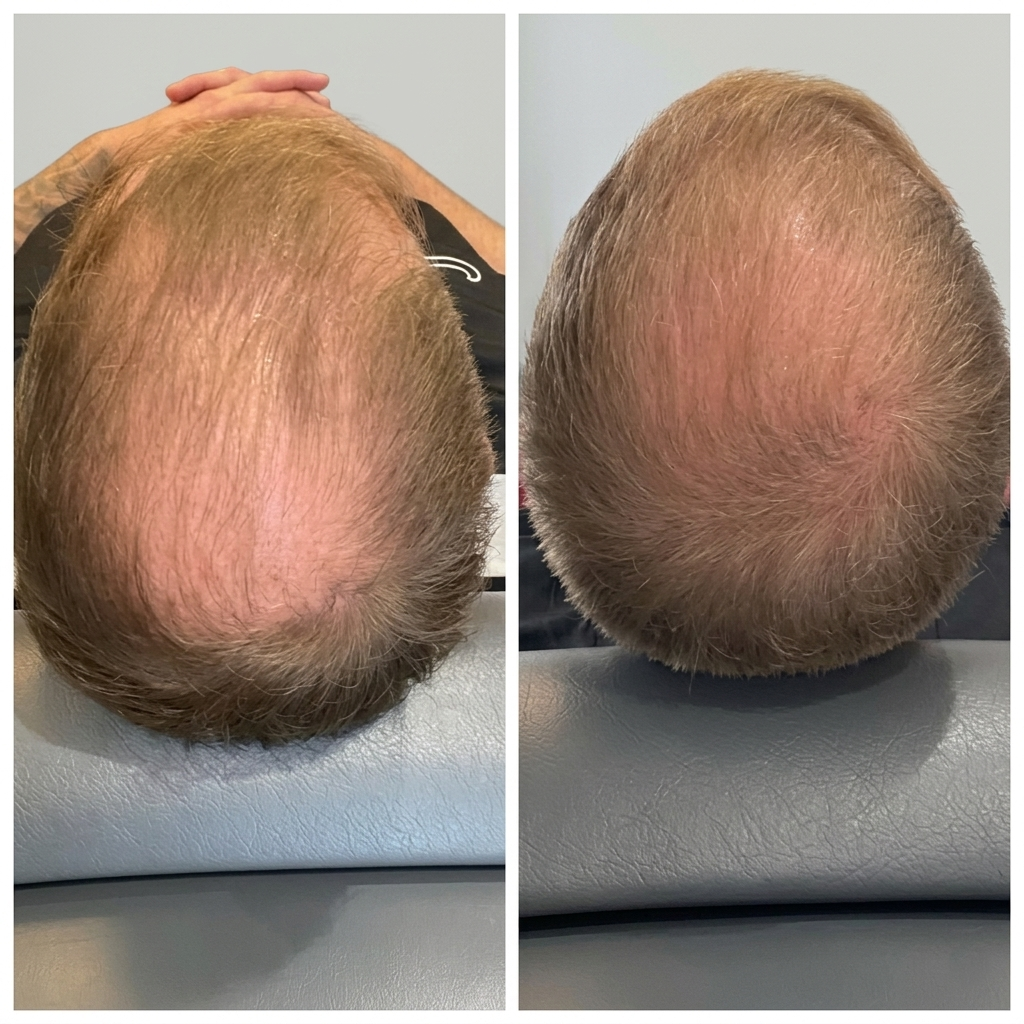
What About Exosomes for Hair?
Hair and scalp applications are another area generating significant interest.
The research around extracellular vesicles and hair biology is still developing, but investigators are exploring how cellular signaling may interact with the environment around hair follicles.
This is where it’s especially important to separate potential from proven results.
Exosomes should not be presented as a guaranteed hair-regrowth treatment or as a replacement for established hair restoration procedures. For someone experiencing thinning hair, the underlying cause matters enormously. PRP, for example, is a separate regenerative treatment with a different mechanism and a much longer history of clinical use in aesthetic hair restoration.
At MJ Aesthetics, exosome-based treatments may be discussed as part of a broader regenerative approach rather than as a standalone promise of hair regrowth.
If hair thinning is your primary concern, our PRP Hair Restoration page explains how PRP works and where it fits in a hair restoration plan.
Exosomes vs. PRP: What’s the Difference?
It’s easy to group these treatments together because both are discussed in the context of regenerative aesthetics. But they’re not the same thing.
PRP comes from you. A small blood sample is drawn, processed to concentrate platelets, and then used as part of the treatment. The platelets contain growth factors and other components involved in the body’s natural healing processes.
Exosome-based treatments use an external preparation. The exosomes are not produced from your own blood during the appointment. Instead, the treatment involves a prepared product containing extracellular vesicles and their associated signaling molecules.
So while both approaches are discussed in regenerative medicine, their sources and mechanisms are different.
That’s also why the two shouldn’t automatically be treated as interchangeable. Your treatment plan should be based on what you’re actually trying to address, your history, and the particular products and protocols being considered.
Can Exosomes Be Combined With Other Treatments?
Potentially, yes — depending on the treatment plan.
Regenerative aesthetics isn’t necessarily about choosing one treatment and ignoring everything else. Some protocols may incorporate exosome-based products alongside other aesthetic or regenerative procedures.
At MJ Aesthetics, exosome treatment is available as an add-on to selected treatments, rather than being presented as a universal treatment for every concern.
For example, someone already undergoing a regenerative skin or hair protocol may ask whether an exosome-based option makes sense as part of that plan. The answer depends on the specific treatment, product and individual circumstances.
That’s a conversation for consultation rather than a blanket recommendation.
What Exosome Treatments Are Not
This is probably the most important section if you’ve been researching exosomes online.
Exosomes are not Botox. They don’t work by relaxing facial muscles.
They’re not traditional dermal fillers. They aren’t being injected to physically restore facial volume or reshape the lips, cheeks or jawline.
They’re also not a guaranteed hair-loss cure and shouldn’t be marketed as one.
And “regenerative” doesn’t mean “risk-free.” Any injectable or procedure-based treatment needs appropriate assessment, product selection, technique and aftercare.
The quality and source of the product matter too. Not every product marketed online as an “exosome” treatment is equivalent, and the rapidly evolving nature of this field is exactly why patients should ask what product is being used and what the intended application actually is.
Are Exosome Treatments Right for You?
This is one of those treatments where the answer really depends on what you’re trying to accomplish.
If your primary goal is to restore facial volume, a conventional dermal filler may make more sense. If you’re trying to soften dynamic wrinkles, Botox may be the more direct option. If your concern is overall hydration and skin radiance, a skin booster may be more appropriate.
If you’re interested specifically in regenerative approaches to skin or hair, exosome-based treatment may be something worth discussing.
The important thing is not to start with the product. Start with the problem you’re trying to solve.
That’s why our approach at MJ Aesthetics is consultation-first. We look at your goals and the treatment options available rather than assuming one treatment is right for everyone.
You can read more about our Exosome-Based Treatments and how they fit within our broader regenerative aesthetic services.
For another regenerative option using your own platelet-rich plasma, see our PRP Treatments page.
If you’re comparing skin-focused options, our Skin Boosters page explains how injectable skin rejuvenation differs from regenerative treatments.
Book a consultation to discuss whether an exosome-based treatment is appropriate for your goals, or call 437-556-1119.
Mehran Javidan is an International Medical Graduate (IMG) who is not currently registered as a physician with the College of Physicians and Surgeons of Ontario. He provides aesthetic treatments at MJ Aesthetics under physician delegation, in accordance with Ontario’s Regulated Health Professions Act.